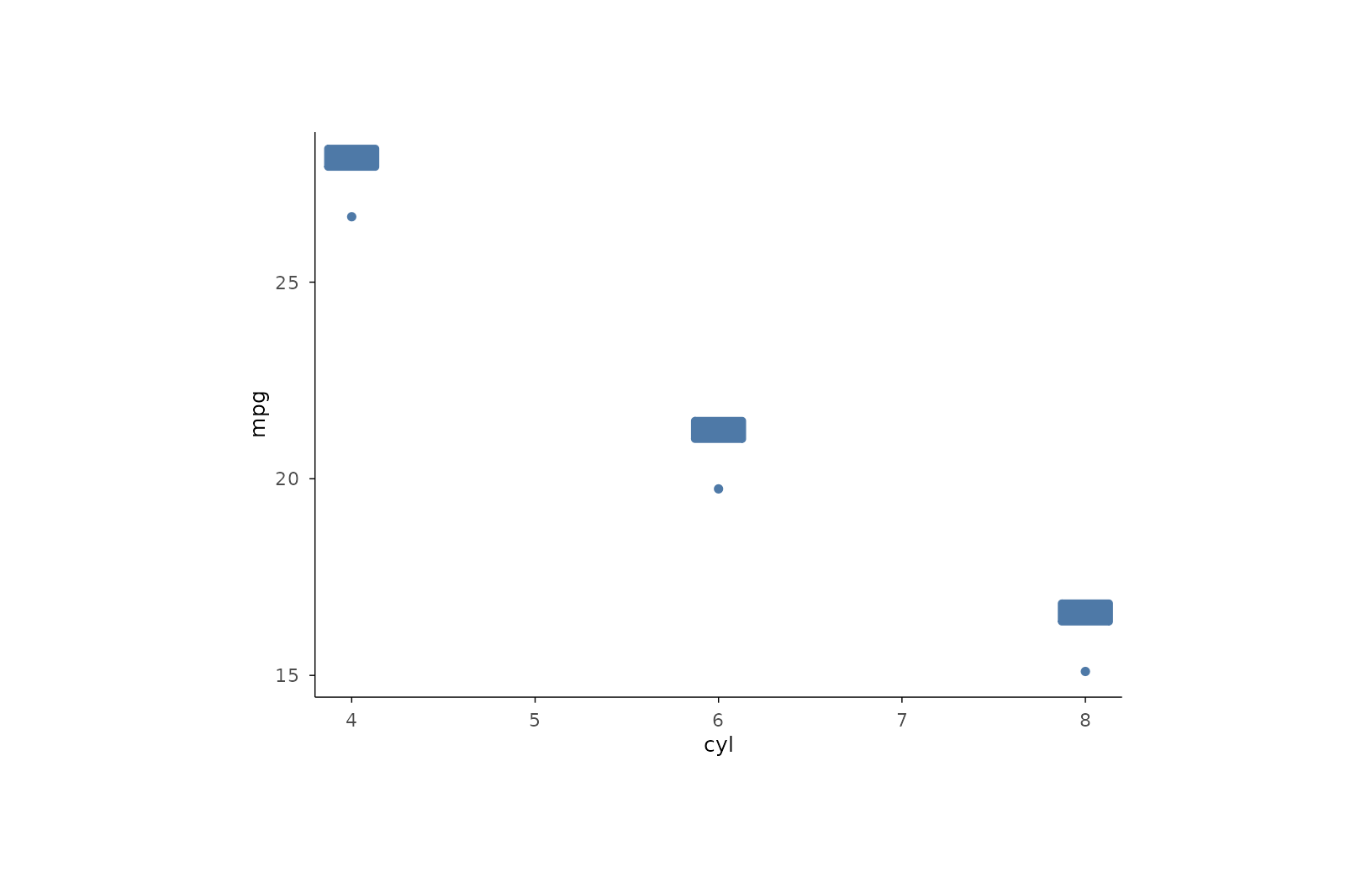
Adds a text layer where every label sits inside a rounded box – the
readable-over-data sibling of mark_text(). For collision-avoiding
placement, install the optional ggrepel package and set
repel = TRUE.
Usage
mark_label(
  plot,
  mapping = NULL,
  data = NULL,
  position = NULL,
  ...,
  repel = FALSE,
  rasterize = FALSE,
  rasterize_dpi = 300,
  rasterize_dev = "cairo"
)
Arguments
- plot
A plotit object
- mapping
Optional new aesthetics (e.g.
encode(label = ...))- data
Optional data for this layer
- position
Position adjustment.
- ...
Other arguments passed to
geom_labelorgeom_label_repel. Withrepel = TRUEthe ggrepel passthrough parameters are the same asmark_text()(see its@param ...for the full list with defaults);geom_label_repeladditionally styles the box withlabel.padding = 0.25,label.r = 0.15,label.size = 0.25. Without repel, ggplot2 4.0 styles the box with thelinewidthaesthetic (the oldlabel.sizeargument is deprecated): usemark_label(linewidth = 0.4);border.colour/text.colourstyle the box and text independently.- repel
If
TRUE, useggrepel::geom_label_repelinstead ofgeom_label. Requires the ggrepel package.- rasterize
If
TRUE, rasterize viaggrastr::rasterise().- rasterize_dpi
DPI for rasterization (default 300).
- rasterize_dev
Graphics device for rasterization (default
"cairo").
References
AntV G2: Text (badge state)
Examples
agg <- aggregate(mpg ~ cyl, data = mtcars, FUN = mean)
plotit(agg, encode(x = cyl, y = mpg, label = round(mpg, 1))) |>
  mark_point() |>
  mark_label(nudge_y = 1.5, size = 3)